"Blind" is a Weighty Word
Blind
When we first got Sky’s diagnosis, the term “visual impairment” was the primary thing we heard.
Sky is visually impaired.
He has visual impairment.
We met a TVI–a teacher of students with visual impairment.
So that’s what I told people–he’s visually impaired or has “vision issues”. It felt softer. I don’t know how it lands with most folks, but I think many assume that means he needs glasses. Which he does. Like many of us–we need glasses to help us read or help us focus our eyes.
When I post photos on social media of him in his glasses I'll inevitably get someone messaging me to ask how we know he needs glasses. Most of us realize we need glasses because we can’t read the letters on the wall in front of us, right? Or we get headaches. Or things look fuzzy. It’s so subjective. But we can’t ask him what he sees.
Or rather, he can’t tell us. Yet.
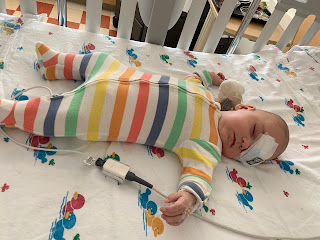
We know he needs glasses because a surgeon took out his lenses. We know he has structural impairments in his eyes that impact his vision. We know he has impaired vision.
It wasn’t until many months after his diagnosis and surgeries that I finally got the nerve to ask The Question of my therapy team: is Sky blind?
To me (before), blindness meant total loss of vision. Seeing dark. Seeing nothing. I hadn’t ever really thought deeper about it. I hadn’t ever been asked to. Blind people use white canes or seeing eye dogs. They wear dark glasses and read braille.
Would that be Sky?
It’s like there was this liminal space between “visual impairment” and “blindness.” We got used to saying he had impaired vision, but acknowledging that he is blind felt like another layer being exposed. It felt raw.
It turns out that the majority of people who are blind can see something. According to the Perkin’s School for the Blind, only about 10-15% of blind people are completely blind. The rest can either see just peripherally (I read one person describe it as having a dinner plate in front each eye that she could see around), or just centrally. Some can see colors or shapes or light variations.
I saw a photograph on a FEVR support group taken by a woman who has FEVR that affects only one eye. She took a photo of a tree in her front yard and then edited it to attempt to show what it looks like in her affected eye. It was mostly fuzzy green with blurred outlines.
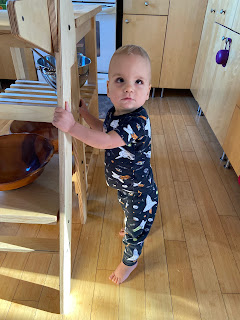
We knew early on that Sky could see light and dark. He looked up every time we turned on the bathroom light, and has always been drawn to windows. At 18 months his favorite thing to do is cruise back and forth at the french doors we have to the back yard. Or he’ll crawl to boxes of light on the floor made by the sun coming in the windows. His favorite toy as a baby was Ollie the Octopus–a silicone touch lamp I got at Home Depot (that was explicitly NOT A TOY, of course). It was his best motivator for moving around the crib or learning to scoot and crawl.

Those facts alone are enough to say he’s blind. We still won’t know how much he can see until he can tell us, but yes, he’s blind.
This took some getting used to. Graham and I had to say it out loud to each other. We tried it out in conversation with our parents and friends. And we started using it more when introducing Sky to new people.
It was interesting seeing the responses–blind is a much more potent word than visually impaired. Obviously it is–that’s why it took us months to start using it ourselves. When I caught up with friends I hadn’t seen in a few months and said something about him being blind, they often were caught off guard–”Wait, what? I knew he had vision issues and had surgery, but he’s blind?” It just carried more weight.
And I realize now it’s just more accurate. The weight is what we need. Our child is blind. He has a disability (that word deserves its own post, and it will get one). He’s not going to miraculously regain his sight–and that is okay. He can live a full and complete life while being blind. I think we were probably protecting ourselves from the weight of it, in part due to our own ableism and the ideas we had for what parenthood would look like.

Blind is a weighty word. We are carrying that word now. We’ve chewed it enough, felt it in our mouths, and have gotten used to saying it.
And the reality is–well, it’s just our reality. There’s nothing wrong with him. His eyes just don’t work like ours. So we get to try and see the world as he does, and tell him about the world as we see it. We narrate. We tell him about colors and what he’s smelling and what the light is doing and what he’s touching and who is that across the room and what’s that sound. We tell him everything.
And we’ll continue to do that until he’s able to tell us how he sees the world in his own way.
Isn’t that just every parent’s job, afterall?
Comments
Post a Comment